
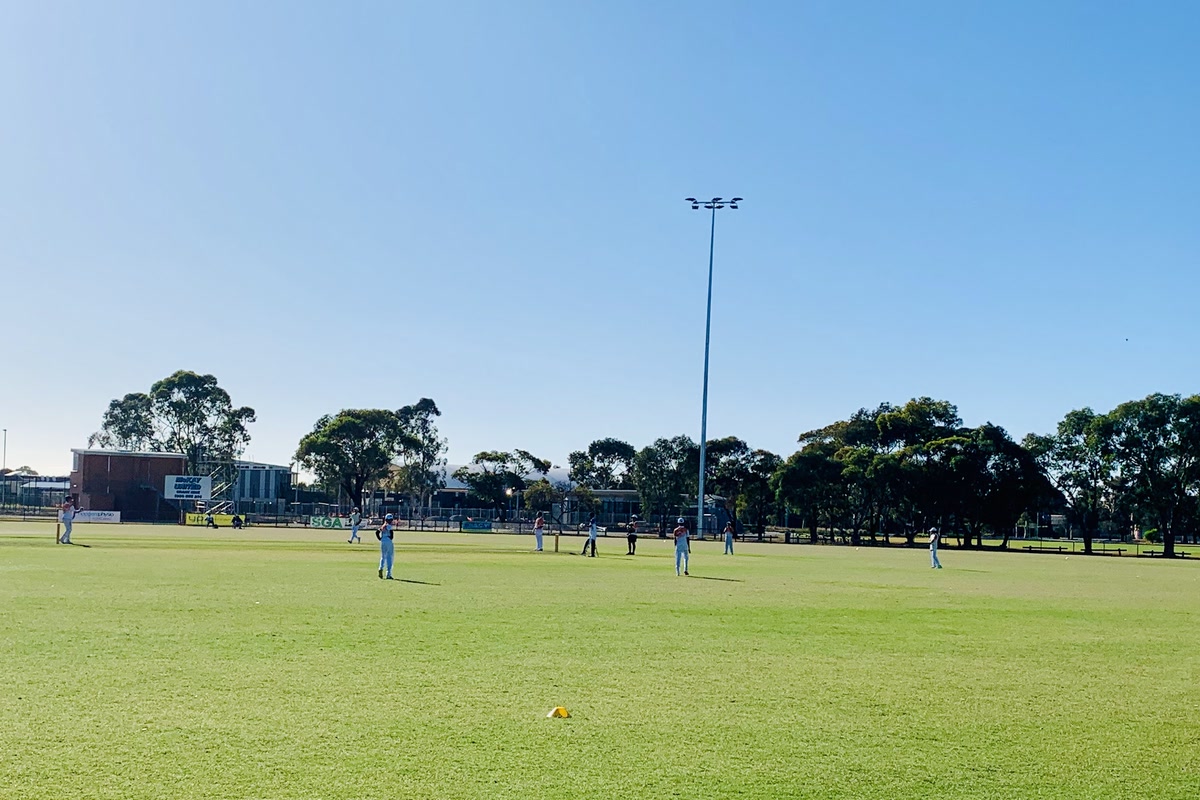
Every VECL match in Melbourne is played on turf. It is the first thing the league says about itself, and it is one of the questions parents ask most: why does the surface matter so much, particularly for a 10 or 12-year-old? This post explains what turf is, what changes for a young player, and why the league built its competition around it.
What we mean by turf
A turf pitch is a natural grass pitch: a strip of rolled, closely mown grass over prepared soil, looked after by a curator. A synthetic pitch is a manufactured mat or carpet laid over a concrete or compacted base.
Both have a place. Synthetic pitches are durable, cheap to maintain and play much the same from one week to the next, which is why so much junior and community cricket is played on them. But they are not the surface the higher levels of the game use. Premier cricket, the Dowling Shield and representative cricket in Victoria are played on turf, and that is where a talented junior’s cricket eventually leads.
What changes for the batter
On a synthetic pitch the ball tends to come on at a consistent height and pace. On turf it can vary: a little more bounce from one end, a ball that grips and stops, another that skids through. The surface also changes during a match and across a season, as it dries out, wears or takes moisture.
That variation asks a young batter to:
- Watch the ball for longer and play later, rather than committing to a shot on length alone.
- Judge length honestly, because a ball that would sit up nicely on a mat may not on grass.
- Read the conditions, noticing how the pitch is behaving and adjusting their game to it.
- Build an innings, because runs often have to be worked for rather than taken on the bounce.
These are exactly the habits coaches try to build. Turf simply makes them necessary.
What changes for the bowler
For bowlers, turf rewards skill more directly. A seam bowler who hits the seam can get movement off the pitch. A spinner who gives the ball a rip can find grip and turn, especially as a pitch wears. Bowling a consistent line and length becomes more valuable, because the surface will do some of the work when a ball lands in the right place.
The league’s competition rules cap each bowler at three overs in a 20-over innings, which means more players get to bowl, and more of them learn how a turf pitch responds.
What changes for keepers and fielders
Wicketkeepers have to deal with more variation in carry and bounce, and learn whether to stand up or back. Fielders on a grass outfield learn to read how the ball runs and bounces, and how a damp morning outfield slows it down. None of it is complicated, but all of it is learned by playing on it, not by being told about it.
Recorded, not remembered
Turf is one of three things the league has insisted on since 2024. The other two are appointed officials and scoring and statistics for every match. Together they mean a junior’s performance exists as a record afterwards rather than only in someone’s memory.
That matters for development. A player, a parent and a coach can look back at a season and see, in numbers, what happened: how a batter’s scoring changed across the tournament, how a bowler’s economy held up, where the dismissals came from. The league scores every ball in the VECL app on CricHeroes.
Turf beyond Melbourne
The same thinking runs through the High Performance International Pathway (HPIP). At the Karnataka Institute of Cricket in Bengaluru, players train on four different surfaces — cement, turf, artificial turf and matting — and play matches against Indian opposition. Learning to adjust from one surface to the next is part of what a camp week is for.
What it means for your player
For a junior who has mostly played on synthetic pitches, the first few overs on turf can feel different. That is normal, and it is part of the point. Most players adjust with regular time on the surface, and the December tournament is played over five days.
Playing on turf this December
The December 2026 tournament is played on turf on 24, 27, 28, 29 and 30 December, for boys Under 10 to Under 18 and girls Under 14 and Under 16, across the Western Falcons, Eastern Panthers and Northern Warriors. Registration is $20 at vecl.au/register/season.
New players can also be seen at the try-outs on Wednesday 4 November in St Kilda or Monday 9 November in Hoppers Crossing, open to anyone aged 9 and over, with bookings closing Sunday 8 November. The try-outs page has the details, and questions go to info@vecl.au.