
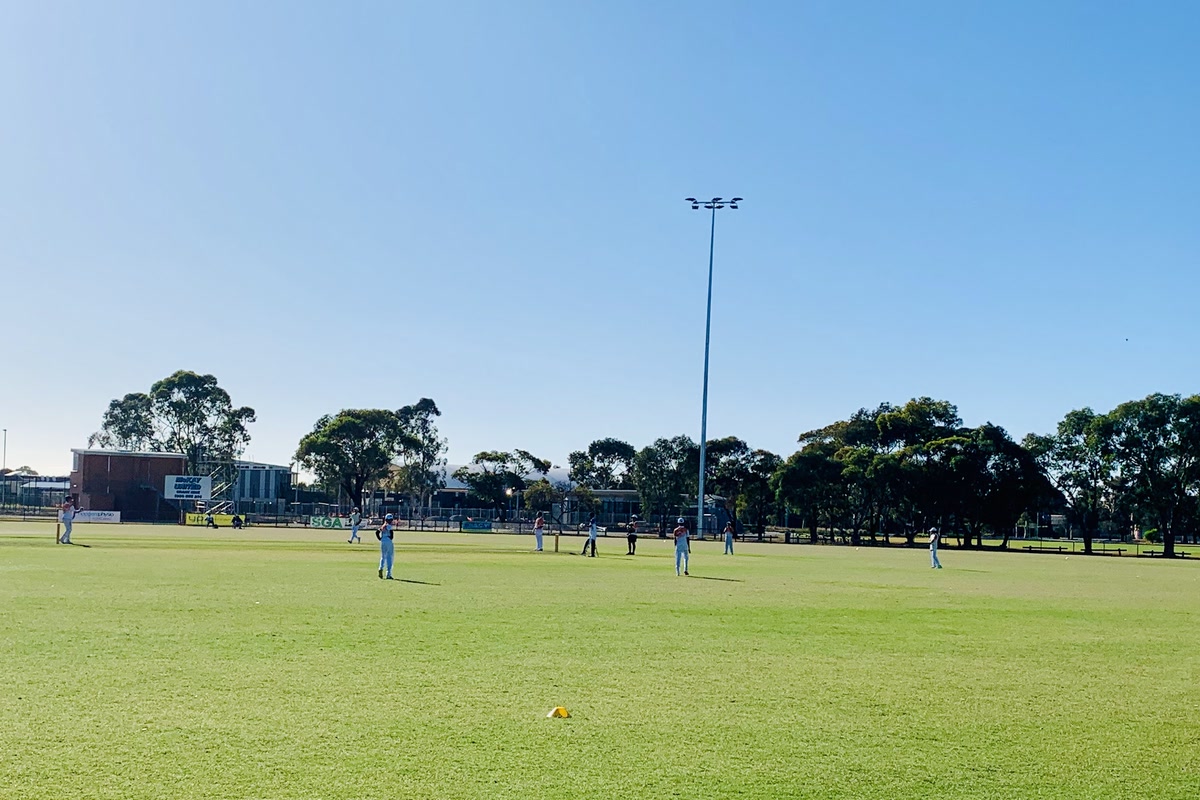
For a player new to the league, the first VECL match day can feel like a step up: a turf pitch, appointed umpires, a scorer recording every ball and a camera on the boundary. Knowing how the day runs takes most of the nerves out of it. This post walks through a match from arrival to the final handshake, using the league’s published Competition Rules.
Before the first ball
Teams arrive no later than 45 minutes before the match. That time is for warming up, settling in and getting organised, not for finding a car park.
A few things happen before the toss:
- Full team sheets go to the scorers no less than 20 minutes before the first match, and each team submits its squad list to the scorers before the toss.
- Only players on that list take part, unless the competition manager authorises otherwise.
- Players are in the correct uniform: the franchise playing shirt, trousers and cap. A player not in the correct uniform may not take part.
- Each team has a manager coordinating its day, and the match has appointed umpires, scorers and a match-day manager.
Matches start and finish promptly at the times in the official fixture list, so being early is part of being ready.
The format: twelve players, three overs each
VECL matches are T20, played primarily on turf under the Laws of Cricket (2017 Code), with a few league conditions that shape the game:
- Each team has 12 active players, all of whom can field and bowl. Only 11 or fewer may bat.
- Each team bats once and bowls once, for 20 overs.
- A bowler may bowl a maximum of three overs. In a 20-over innings that means at least seven bowlers get a turn.
- Each innings has 1 hour 20 minutes, with 10 minutes for the change of innings.
- Ends change every five overs. Batters change ends when a bowler completes an over, but not when the fielding side changes ends at the five-over mark.
Juniors play with white leather balls: 142g for Under 10, 11 and 12, and 156g for Under 14, 16 and 19, boys and girls.
Powerplay and power surge
Two fielding restrictions give each innings its shape.
The powerplay is the first four overs. During it, a maximum of two fielders may be outside the inner circle. After it, a maximum of five.
The power surge is two overs the batting team chooses, from the 11th over onwards, with the same limit of two fielders outside the circle. If the batting team has not taken it by the 18th over, the umpires apply it automatically for the 19th and 20th.
For a young batter it is an early lesson in match awareness: when to accelerate, and when to build. For a captain, it is a decision to plan for.
When the weather turns
Rain shortens matches rather than simply ending them. Delays reduce playing time and overs, Duckworth–Lewis applies, and five overs per side constitutes a match.
The accredited umpire decides whether play continues. If thunder follows a lightning flash by thirty seconds or less, play stops immediately and everyone takes cover. The Wet Weather and Extreme Weather Policy has the full rule.
Disagreements, and the end of the match
On the field, the umpire’s decision is final. A player who disagrees tells their captain, coach or manager during a break or after the match. If a dispute does arise, every effort is made to settle it at the ground on the day, first with both umpires and then with the management of the teams present. Any formal protest has to be made in writing within 24 hours of the match finishing.
When the last ball is bowled, players thank the opposition and the officials, whatever the result. It is part of the Player Code of Conduct, and one of the habits the league most wants juniors to take with them.
First aid kits are provided at league matches, and the full scorecard stays in the VECL app afterwards. Recent results are gathered in the Match Centre.
Your first match day
December 2026 match days are 24, 27, 28, 29 and 30 December, with venues announced with the draw. Register for the December season for the $20 team selection fee. The parents centre answers the common questions, and anything else goes to info@vecl.au.